
 1 hour ago
2
1 hour ago
2
Andy Burnham had emerged victorious, but niggling doubts remained about his mandate. It was the summer of 1987 and the 17-year-old had represented Labour in a school hustings as Margaret Thatcher and Neil Kinnock were battling it out in that year’s general election.
“Andy was standing against another guy, a really nice guy who was the Conservative candidate,” said Steve Harrington, a former English teacher at St Aelred’s Catholic high school, in Newton-le-Willows, Merseyside. “Andy gave a speech, which was excellent, then the other guy came on to make his speech and Andy’s fans – unbeknown to Andy – snatched the plug out of the microphone. So they couldn’t hear what he was saying. Andy won by a landslide. Having said that, he probably would have anyway, as it was a heavily Labour area … But he was innocent, he hadn’t been involved in [the prank] and wouldn’t have been.”
If there was a whiff of illegitimacy to Burnham’s first election, his uncontested selection by the Labour party to be the UK’s next prime minister now leaves him with a particularly fraught task: create the change he has promised without clear electoral backing. He will need to outline a vision more sharply than the outgoing prime minister, Keir Starmer, defying his critics’ caricature of him as a man without principle: a “Captain Flip-flop”.
It is the contention of many of those closest to him that Burnham will be aided by what they claim is a remarkable consistency in the 56-year-old’s “communitarian” belief that people can only enjoy their individual rights if rooted in well-functioning communities with control over their surroundings.
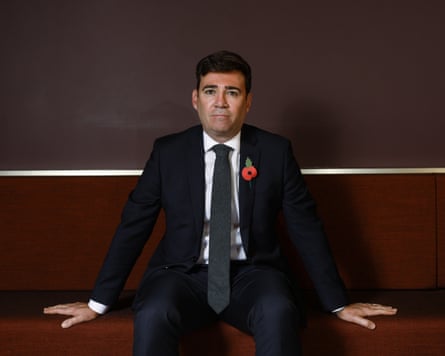
Friends note that, two decades ago, Burnham worried privately with aides that children would need to be protected from the “wild west” of the internet. He had a huge mock-up of an ID card in his office as a junior Home Office minister. Today, he talks about public control over utilities and an active state directing planning and investment. There is a thread, they say.
As to the character of the new prime minister, the picture painted by those who know him well is that of a warm, affable man who likes to be liked. Burnham is a Cambridge graduate and poetry lover who insists on writing his own speeches, but picks up policy ideas while doing the family shop at Asda and Costcutter. He counts his mother, Eileen – a retired receptionist at a GP surgery – as a political sounding board.
Yet, there is perhaps another side that is underappreciated. He has been willing to risk the closest of relationships, including with his new chief of staff, when determined on a course of action. In 2020, he declined to support the leadership bid of Keir Starmer, who had backed Burnham’s own attempt to be Labour leader in 2015, on the grounds that he would not choose him over north-west MPs and fellow candidates Lisa Nandy and Rebecca Long-Bailey.
“They had been pretty tight but Keir loathes him now,” said a source close to Starmer. Burnham is said to be capable of being extraordinarily stubborn. “There is a steeliness,” said a longstanding friend, who added that they believed this would lead to another bold decision. “I think he will want to go to the country [for a general election] sooner rather than later. He will want his own mandate.”
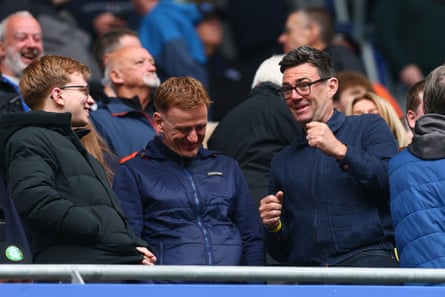
The source added: “And being home for the weekends for the family and Everton is sacrosanct. If people think that Keir dug in over [attending] Arsenal games, it is non-negotiable [for Burnham]. It is not for spin – he will not give that up.”
Burnham was born in Aintree, Merseyside, but brought up in Culcheth, Cheshire, after his father, Roy, a telephone engineer, was promoted by the Post Office to a job at Dial House, in Salford. He has described his childhood as “wonderful in every way”.
Ian Riley, a family friend and maths teacher who taught Burnham’s older brother, Nick, lives opposite what used to be the Burnham family home, then a bungalow. “Always immaculately kept,” he said. “A lovely family. Never flashy.”
Riley needed to have a word with Burnham when he only just made it into the higher-achieving O-level set rather than the lower CSE. “I think I must have made a judgment that Andy probably was a bright lad and had got it in him [to do better],” said Riley. Burnham went on to get an A in maths.
The family were “politically aware but not wearing it on their sleeve”, Riley added, although one of Burnham’s nephews “always has a pithy political comment to make – not a great fan of the royal family, I don’t think”.
“Andy’s mother is a great driver,” said Riley of the influence on her son’s ambition. “I absolutely would not mess with Eileen Burnham.”
Harrington, who recalled the school hustings, taught Burnham English at A-level and perhaps changed the course of British political history. “He went into sixth form intending to do Spanish at university, but changed his mind because, in the process of preparing him for the Cambridge interview, I spent quite a lot of time going through Tony Harrison’s poetry,” said Harrington. “He was totally taken by this because Tony Harrison’s poetry is very much about his life in Leeds, being working class, all that he had to put up with … I lent him my video cassettes at the time.”
Burnham’s parents were “madly enthusiastic” that their son, the middle of three boys, should try for Cambridge. “I just kept trying to persuade him to change his mind and give it a go,” said Harringon of a reluctant Burnham. When he retired, Burnham was the surprise guest for the man who “changed his life”.
Burnham has spoken of suffering from “impostor syndrome” while at Fitzwilliam College, Cambridge, but it is where he met his Dutch-born wife, Marie-France van Heel, known by Burnham as M-F. A no-nonsense character, said an acquaintance. “It’s a partnership, but I can’t see her glad-handing at summits,” they added, “and she won’t be interested in moving to London.” Between studies and playing cricket and football, Burnham dipped his toe into student journalism, writing six articles for the sports pages of the university newspaper, Varsity, on karate, football and cricket.
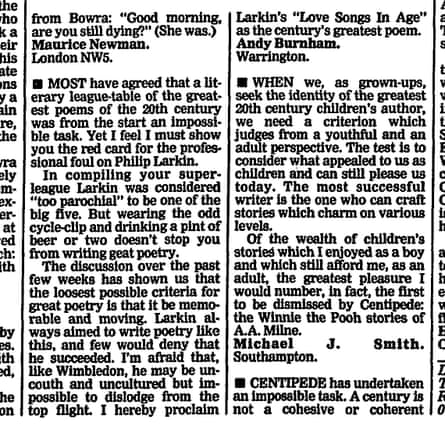
He graduated with a 2:1. In October 1991, after returning home at the age of 21, he wrote to the Guardian to complain that Philip Larkin had not made the newspaper’s league of great poets. “Wearing the odd cycle-clip and drinking a pint of beer or two doesn’t stop you from writing great poetry,” wrote one Andy Burnham, of Warrington. “I hereby proclaim Larkin’s Love Songs in Age as the century’s greatest poem.”
Work experience followed at the now defunct newspaper Middleton Guardian before moving to London in 1992 for a job with Baltic Publishing, in Brentford, contributing to magazines such as Tank World and Container Management. There he met Eleanor Mills, the stepdaughter of the Labour MP and future culture secretary Tessa Jowell. Mills suggested over drinks that he apply to her stepmother for a parliamentary assistant role.
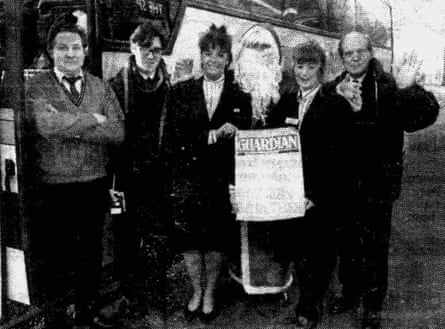
Burnham helped Jowell work on Tony Blair’s leadership campaign and the 1997 election 1997 election that Blair won in a landslide before taking up roles as a parliamentary officer for the NHS Confederation healthcare body and then as an administrator on a football taskforce established by the sports minister, Tony Banks, to give fans a bigger say in the game. A stint as a special adviser to the culture secretary, Chris Smith, followed. In 2001, Burnham realised his dream of becoming an MP in Leigh, near his family home.
Arriving in parliament, Burnham shared office G38 in the Norman Shaw Buildings with fellow former special adviser James Purnell. Two and a half decades later, Burnham would make Purnell his chief of staff in Downing Street. “They were very close and Jonny Reynolds [the chief whip under Starmer] was working with James in his constituency and was down all the time,” said a source. “There would always be a football being kicked around the office, a rugby ball in the air.” A sofa in the office became something of a “dumping ground”. The biggest trouble for aides was “getting meetings with Andy to finish on time … kind of keeping him to schedule”.
A regular visitor to the office was the then home secretary, David Blunkett, for whom Burnham took up the role of parliamentary private secretary. “It was a great learning curve for him,” said Blunkett, who has remained a mentor. “There is a consistent theme [to Burnham]. I don’t think he would describe himself as a communitarian, but I think he is.”
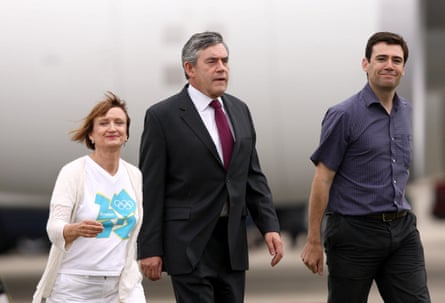
Blunkett would later urge Burnham, as mayor of Greater Manchester, to bide his time before seeking a return to London. “I used to joke with him that in 1917, Lenin [exiled] in Switzerland made the quip that timing is everything – and it is.” He spoke to Burnham a few days ago. “He’s feeling pressurised, understandably so – all of this has happened very quickly indeed,” Blunkett said. His advice had been to “make clear that you’re not going to do everything on the hoof, you’re going to come back in the autumn when you’ve had the chance to really think this through and have appointed a new cabinet and that’s the moment to set out the second bit of your stall”.
Burnham was made a minister in Blunkett’s department and then in the health ministry. “The first thing he did was go undercover in the NHS and then write a report about it,” a former colleague recalled. “It pissed a lot of people off in the department actually: ‘Who does he think he is?’”
Burnham played the political game well in 2007 when he was one of those who formed a “Blairites for Brown” group as Blair, the prime minister of 10 years, prepared to stand down, with Brown the runaway favourite to take over. He was rewarded by Brown with his first cabinet job: chief secretary to the Treasury. As signs of the 2008 global financial crisis were emerging, he had to argue down the spending departments. It was, said an insider, a “baptism of fire”. “Ed Balls and Yvette [Cooper] tag-teamed,” the source recalled of the then education secretary and housing minister, who are married. “Ed was really hard. They were just quite brutal. Yvette can be quite icy. They passed the phone between each other.”
Promoted to culture secretary, Burnham visited Anfield in 2009 to commemorate the 20th anniversary of the Hillsborough disaster in which 97 Liverpool fans died. As he offered words of condolence, the then 39-year-old minister’s speech was interrupted by angry calls for justice. A series of governments had refused a public inquiry. “My journey away from Westminster began at Anfield that day,” Burnham later said.
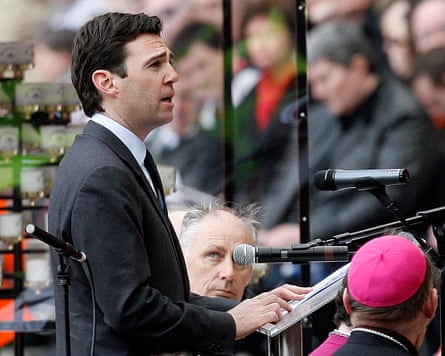
There were other factors at play in his dwindling affection for life in the House of Commons though, a friend suggested. Burnham was caught up in the notorious expenses scandal of 2009 when it was revealed that he had lobbied the House of Commons fees office to approve £16,644 in expenses for a flat in Lambeth, south London. After being rejected three times, Burnham had written a note claiming he “might be in line for a divorce” if left out of pocket. The money was paid.
There was no suggestion of wrongdoing but “it was a horrible period”, said a friend, “and there was some personal stuff too”. Burnham’s sister-in-law died from breast cancer. It was discovered that Marie-France had the same BRCA1 gene mutation and she underwent a preventive double-mastectomy. “She had got some horrible press as well because of what she wore to a frigging event,” the source said. “It was just a time where it was all a quite exhausting and a bit relentless.”
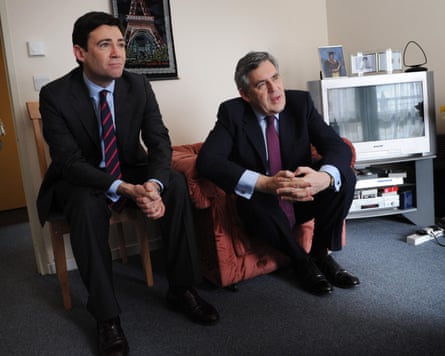
That year, Burnham had a further personal and political dilemma. Purnell had decided to resign from the cabinet in an attempt to oust Brown from Downing Street. Burnham told his friend that he would not follow him. “I think Andy just didn’t see it ending well,” said a confidante. “It made it tough for a little bit. They’d always come to places together and this was an issue where James took a fundamentally different take. Andy was also sad because he knew the two of them wouldn’t be the two of them for a bit.
“I think people who knew Andy well knew he wasn’t going to go – I think James knew really. There was definitely a frustration with Andy, but Andy can bed in a bit. James did what he had to do and what was right for him. And I think Andy did what was right for him.” Burnham was made health secretary after Purnell’s resignation.
The loss of the 2010 general election opened up the question of Labour’s leadership again. Burnham was under pressure to step aside for David Miliband, who had been foreign secretary, whom he who he found condescending at times. But he “felt he had something particular to say”, said a friend. The contest was dominated by a fratricidal battle between David and Ed Miliband, who had also served in the outgoing Labour government. “Andy just couldn’t get his head round that,” recalled a source. “Maybe he will make Ed chancellor, but he saw some pretty grim stuff.”
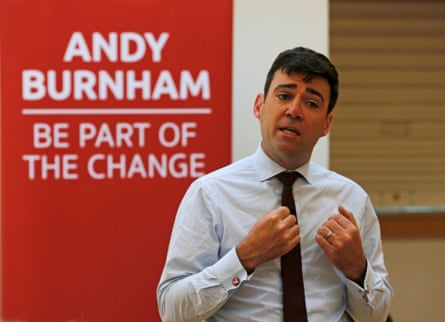
Burnham’s own campaign struggled. Stickers bought for a campaign bus that was to be presented in a Glasgow car park were found to have spelled Burnham’s name without an “n”. Aides stood in front of the bus in order to cover up the error. But such was their panic that they failed to spot that Burnham was positioned in front of a “defend the NHS” slogan in such a way that it read “end the NHS”. “He didn’t shout like others would, he never did,” said a source. A second insider added: “Even when there were tensions at home – and he has had to make a lot of sacrifices – Andy never shouted.”
With Ed Miliband’s election as Labour leader, Burnham became the shadow health secretary. The leader of the opposition’s office found him to be difficult. “I think after the leadership election, he just felt empowered to speak up more – it caused tension,” recalled an insider. Burnham felt there was not enough ambition on social care. Miliband’s press team briefed that Burnham could be sacked.
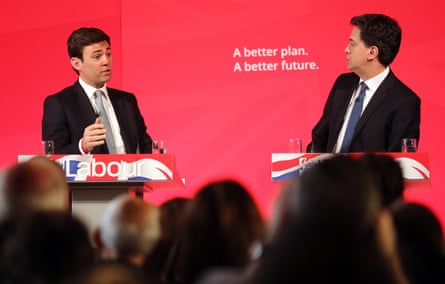
After the 2015 election was lost, Burnham was the favourite to take the top job within Labour but “we fought the wrong election – appealing to the public not the Labour membership”, said a source. Burnham refused union funds and emphasised his fiscal discipline.
Buoyed by an influx of new members allowed to vote in the election in return for £3, Jeremy Corbyn forged ahead with a radical agenda from the left, beating Burnham heavily into second place. As Corbyn celebrated his win, Burnham was left picking at “an entirely beige buffet” at a dingy pub in Marylebone where a “wake” rather than a victory party was being held. “Don’t worry Andy,” said Charlie Falconer, the ever-optimistic Labour peer and Burnham backer. “There’s always a third time”. Few, let alone Burnham, believed it.




 English (US) ·