
 4 hours ago
1
4 hours ago
1
Christopher Nolan reinvents the Homeric legend as a colossal origin-myth story of postwar disillusion, an epic ordeal of anguish witnessed by the dead and presided over by capricious deities who participate on almost equal terms with the humans. It speaks to the generational pain of PTSD; plenty of soldiers come home in person after any war promptly enough, but arriving back to their prewar state emotionally or spiritually can take years or decades and may never happen at all. The invisible odyssey of anguish is punctuated by flashback episodes, hallucinations, confrontations with the arbitrary gods of dysfunction. And all the time the spouses and children cannot move on with their lives.
This is a film with thrilling ambition, boldness, seriousness, generosity and flair. There are some broad-brush moments in the dialogue, yes, but even these are applied with a muscular flourish. It has gasp-inducing, Imax-sized landscapes of loneliness shot by cinematographer Hoyte van Hoytema – who, incidentally, avoids the sea’s traditional cliched colour – and full-tilt battle sequences and fight scenes accompanied by the throbbing and thrumming of drums.
Matt Damon plays Odysseus, his boyish, almost cherubic face turned into a careworn mask of sadness. He is the military commander from Ithaca appointed by the Greek king Agamemnon, played by Benny Safdie, his face always mysteriously masked in a Batman-type helmet. (Another echo of Nolan’s previous work is detectable in the troops’ endless wait on the beach, as in Dunkirk.) Odysseus reveals to Penelope (Anne Hathaway), the wife whom he is about to leave and whom he advises to remarry if he dies in battle, that the notional cause for the imminent war with Troy – the elopement of Helen (Lupita Nyong’o) with Trojan prince Paris – is a pretext. It is a banal commercial contest for trading routes.
The Greeks’ eventual victory is achieved after a brilliant tactical deception: an elite combat unit hides cramped in a huge horse statue, which is not rolled into the fortified city on casters as a gift, but dragged inside by its own victims as a precious object from the surf, half hidden in the sand. It’s a trick that involves Odysseus having to deceive his own comrade and cousin Sinon (Elliot Page), a blood sacrifice for which he feels unending guilt. Nolan recreates the Trojan horse as a cross between the Statue of Liberty from Planet of the Apes and Shelley’s statue of Ozymandias.
The point is that the war, its supposed aims, its storied strategic success and presumed outcome are all irrelevant compared to the long, bizarre chaos of the aftermath, the giant toxic effect that follows the forgotten cause, as demoralising as a retreat that follows catastrophe. Agamemnon returns home to be killed; his brother Menelaus (Jon Bernthal) is grimly reunited with Helen, in which role Nyong’o also doubles as Agamemnon’s killer Clytemnestra. Meanwhile, Odysseus and his men, tormented and disoriented with hunger and loss, embark on their own chaotic sea journey of survival, meeting Harryhausen-type monsters such as the Cyclops, the Laestrygonians and Circe (Samantha Morton), Calypso (Charlize Theron) and the alluring Sirens, but also the sorrowing goddess Athena (Zendaya), who is Odysseus’s ally.
And at home, to stall for time and contain the potentially violent power vacuum contingent on Odysseus’s assumed death, Penelope is forced to entertain dozens of potential marriage suitors as guests at a humiliating and continuous bacchanal of greed. The most prominent is the creepy Antinous, sleekly played by Robert Pattinson, who is cruel to Odysseus’s blind manservant Eumaeus, an emotional, sympathetic portrayal by John Leguizamo. Odysseus’s psychically wounded son Telemachus (Tom Holland) must now embark on his own odyssey, to find his father, or his father’s corpse.
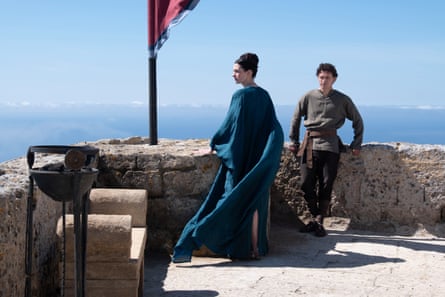
When Odysseus has to descend into the underworld to converse with the dead, it is an unforgettably strange scene: Nolan has the shrouded spirits hunch above ground like the witches in Macbeth. The dead, like the gods, can be contacted on an almost level playing field; this is the bizarre pagan rule of the Odyssey, as opaque and amoral as the secular symptoms of psychological breakdown. And yet when Odysseus finally approaches Penelope’s house, now under brutal siege from suitors in parallel to the siege of Troy, he does so in the Christ-like disguise of a beggar. In the final movement to this story, Odysseus begins his own mysterious metamorphosis into a god.
One part of the Homer original that Nolan doesn’t include is the hero’s roguish grandfather Autolycus, who named him and by that token gave this story its title. Odysseus means “victim of enmity” – though variant translations have ingeniously and insightfully rendered that as “giver or initiator of enmity and hate”. Still, it is perhaps the most unimprovable name an action hero can have: vivid, elemental, existential. He is the victim of no single enmity, except arguably that of Antinous, but enmity all around, an ecosystem of enmity, the hostile terrain through which he must pass to reach the even more hostile terrain of home.
The result is a gigantic, shimmering mirage, a mysterious three-hour vision of crazy episodes that does not yield up wisdom or contentment, but only a grim resolution to continue with the fight, to make sense of ruined lives, to re-enter the scorched battlefield of loss.






 English (US) ·