
 5 hours ago
1
5 hours ago
1
In the dark of a sold-out Prudential Center in Newark, New Jersey, a screen lights up on a desert. Around me are girls and their moms in concho shell belts and coined hip scarves, and there are Colombia soccer jerseys and the country’s traditional vueltiao hats as far as you can see. An uncanny CGI figure of Shakira shakes loose the sand. She looks to be covered in a silvery oil slick. I immediately recognize the Shakira of the La Tortura video I saw on MTV’s TRL in 2005, her stomach flickering in fluid, controlled movements. She pounds the sand, and a silver-sequined Shakira emerges, first on screen and then on the floor.
“There’s nothing like when a she-wolf reunites with her pack,” she howls.
This is Shakira’s Las Mujeres Ya No Lloran tour, offering Shakira for every era. The tour is titled after a memorable lyric from her 2023 session with the Argentinian producer Bizarrap that broke 14 Guinness World Records that year and ushered in a Shakirassance that continued with the album it would name: “Las mujeres ya no lloran / Las mujeres facturan,” she sang. (“Women don’t cry any more / Women make money.”)
Make money she has. Tonight marks one of her final dates on the North American leg of this historic tour. Running since February of 2025, it is now the highest-grossing tour of all time by a Latin artist, with $421.6m in ticket sales when it clinched the record in January. It will close in October in Madrid with 12 nights at her titular stadium, Estadio Shakira.
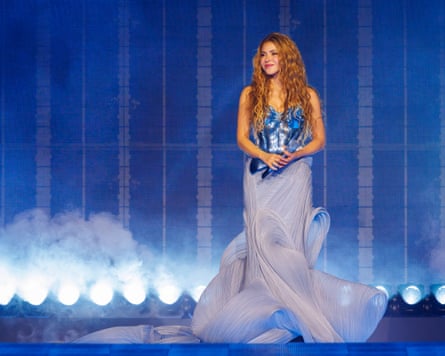
An onscreen procession of Latin American flags on Girl Like Me reminds us why we’re here in New Jersey. It’s a big week for Shakira: on Sunday, she’ll headline the first ever World Cup final half-time show at New York New Jersey Stadium alongside Madonna, BTS and Coldplay.
And then, we’re reminded of how she got here. She segues from Las de la Intuición – a song honoring a woman’s intuition from the 2005 album Fijación Oral Vol 1 – into the Pretenders-sampling Estoy Aquí from her 1995 breakout album Pies Descalzos, which first made the 18-year-old Shakira Isabel Mebarak Ripoll a star across Latin America.
A medley of 2014’s Empire into 1998’s Inevitable underlines Shakira’s roots as a rock star. She plays a glittering white guitar, and her voice soars with those of us singing our hearts out to her most cathartic track. It’s a revival of rockera Shakira, the one with red streaks in her black hair whose classic album Dónde Están los Ladrones? kept so many girls with messy feelings company. This Shakira, she sings, cries at least once a month. On Can’t Remember to Forget You, after the lights go down before Rihanna’s part, they blaze back to show Shakira behind the drums banging thrillingly through the song’s final crash. She’s wearing a huge smile.
During a bit of stage banter, Shakira acknowledges that her life in the past few years has been difficult. She says: “As a writer I admire very much, Isabel Allende, said: ‘Women alone are vulnerable, but together we are invincible.’” She leads into 2005’s Don’t Bother from Oral Fixation, Vol 2, the English-language counterpart to Vol 1. Her stilted lyrics, a relic of the crossover project, place Shakira in contrast to an ex’s seemingly perfect new girlfriend.
If there’s a disjointedness here, Shakira has made a career of surmounting it. Rockera Shakira seems like a stranger to oil-slick Shakira, positioned by the industry as a sex symbol in the Garden of Eden – so much so that a decades-old conspiracy concerning her secret replacement by a blond doppelganger persists into the present.
Before I can think too deeply about this, the set literally catches fire during La Tortura. With a combination of reggaeton and Colombian vallenato, Shakira ignited an industry in the US that would see Colombia’s place in reggaeton develop into a glossier and softer interpretation of the genre. Nowhere was this spark more apparent than Hips Don’t Lie, brought to life tonight spectacularly with Newark’s own Wyclef Jean as a surprise guest. His lyric “Refugees run the seas” lands a little differently in 2026, feeling like a glimmer of a resolute spirit in one of the most commercially successful Latin pop songs ever.
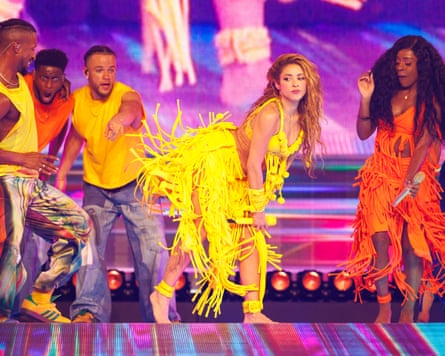
After Chantaje is reimagined with a full salsa descarga jam session and Ojos Así showcases her belly dancing prowess, we’re back in the desert with a poem. “I met that little girl in leather pants, bare feet, the one who wanted to change the world,” she remembers. “And her world changed.” A dark-haired CGI figure has a vision of the teenage Shakira, young and voice full of guttural vibrato, who described wanting to conquer the whole Latin world. She did, in so many iterations of herself.
Shakira is now the sixth most-streamed artist in the world. She is the reigning World Cup musician of the 21st century. African-inspired Waka Waka from 2010 is the spiritual forebear of her theme song for this year’s tournament Dai Dai, which 16 years later, at least now actually features an African artist, Nigeria’s Burna Boy. Dai Dai is now the most-streamed song in the world, topping the Billboard Global 200 Chart and Spotify’s Daily Global Top Songs chart. Shakira remains the first artist to ever reach the top spot on Spotify in English and Spanish.
And while I regard this superstar Shakira like a monument, I revere the young woman whose weird impulses would eventually find her staging a larger-than-life inflatable wolf during her encore. Hundred-dollar bills emblazoned with her face rain down over Prudential in a joyous celebration of every Shakira that minted this one.







 English (US) ·