
 1 hour ago
1
1 hour ago
1
Tracy Jordan, Tracy Morgan’s character on 30 Rock, once advised a friend to live every week like it’s Shark Week. In 2026, Hollywood has finally taken these sage words to heart.
Though Discovery Channel is only observing its annual Shark Week of shark-themed programming for the customary seven days, shark movies have been enjoying a yearlong renaissance – in terms of volume, if not necessarily quality. Two shark thrillers – The Devil’s Mouth on Prime Video and Above & Below as a paid VOD rental – are releasing this week, presumably to complement nonfictional Shark Week programming, but they’re far from the only fish in the sea. Earlier this month, Clint Eastwood’s daughter starred in The Bay, another VOD title. In June, there was Chum, starring Alice Eve; in May, Deep Water, Renny Harlin’s return to the subgenre following his classic Deep Blue Sea. Before that, Thrash was a Netflix hit. That’s half a dozen shark movies so far this year. It’s a wonder no one has arranged a 10th-anniversary re-release of The Shallows.
Obviously there’s a baseline, sellable level of interest in shark thrillers, which are often positioned as something akin to an all-natural slasher: horror movies that expand just slightly beyond the bounds of the world we know (the beach, the ocean, observing nature) and into heightened but not completely outlandish territory. They’re the water equivalent of the masked killer stalking around the woods, only we’ve all seen footage of sharks – thanks to Discovery and the like – so we can all agree that they are definitely out there, and can be deadly to humans – even if the reality is far less gruesome, frequent or vengeful than their movie equivalents.
What makes the pursuit of new shark movies more quixotic than some other horror/thriller subgenres is the existence of a single agreed-upon masterpiece that’s near-impossible to match. While it’s unlikely that any given new landlubber slasher will represent a pantheon-level genre-definer, at least there are a variety of near-perfect classics to emulate: the proto-slasher creepiness of Psycho, the unnerving rural underbelly of The Texas Chain Saw Massacre, the suburban menace of Halloween, the phantasmagorical dreamscape of A Nightmare on Elm Street. With shark movies, it’s Jaws, and then everything else. (Some of those slashers have good and/or interesting sequels with further inventions; not so Jaws, which just has three increasingly ludicrous and cheap brand extensions.) Working from maybe the beachiest beach read of all time with a notoriously finicky fake shark, Steven Spielberg crafted a movie that’s simultaneously a male-bonding character study, an indictment of keep-the-beaches-open American capitalism, and an expertly tuned thrill machine complete with unforgettable theme music. By sheer force of quality, it reinvented the barely there shark movie, and the whole of summer movies along with it.
Eventually, a few particularly strong iterations did figure out how to operate within the shadow of Jaws, though they had to wait out those lousy follow-ups, which reached a nadir in 1987 with the all-time stinker Jaws: The Revenge. Deep Blue Sea, Harlin’s amped-up summer movie from 1999, feels like a Jaws sequel done right: it goes the bigger/faster/crazier route, with genetically modified sharks and noticeably dumber humans. Its thematic is the same old monster-movie scientists-playing-god cautionary tale, but as a creature feature it’s juicy, well-cast (Samuel L Jackson!), and a lot of fun. Another highlight goes in the opposite direction. The aforementioned The Shallows, from summer 2016, strips down the three-men-on-a-boat climax of Jaws even further; most of the movie is just Blake Lively stranded on a rock, attempting to outwit a particularly persistent shark as she grieves the loss of her mother. Director Jaume Collet-Serra has multiple movies that play with Hitchcock-style location limitations; The Shallows is one of his most limited and also one of his best.

The Shallows – along with the more bummed-out survival-thriller indies Open Water and 47 Meters Down – has managed to help redefine the parameters of the shark thriller. Over the past decade, they tend to either follow the Shallows/47 Meters route of a handful of characters, usually women, exorcising some form of trauma or interpersonal conflict through a trial-by-teeth encounter with sharks; or attempt to be sort of a thinking man’s version of Sharknado, the tediously “knowing” D-movie franchise from cable’s SyFy, where sharks are flown into unlikely places or situations. (Think of the recent Netflix hit Under Paris, which contrived irresistible but ultimately schlocky ways for CG sharks to turn up in the Seine circa the 2024 Olympics.) If nothing else, both styles set up more achievable goals than evoking a truly great movie like Jaws.
So how do this year’s crop stack up in that context? Of the two Shark Week releases, The Devil’s Mouth follows the Shallows path, while Above & Below has more of a Sharknado style, though it also borrows heavily from 47 Meters Down. The Devil’s Mouth focuses on friends, led by two besties (Kathryn Newton and Lana Condor), vacationing in Thailand, where they embark on a swimming tour of an off-ocean cave system. The movie, seems, if anything, overly self-conscious about the motivations that are supposed to fuel characters in survival thrillers, which means the two leads both have dead parents, while also engaging in a semi-toxic dynamic that the movie never quite fully defines. As a result, it ultimately feels like it’s a movie about the perils of having a best friend who’s just generally kind of annoying.
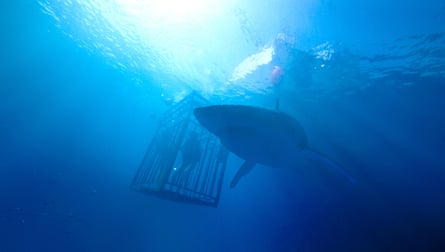
But its location shooting with built-in atmosphere, and the sparing use of shark effects this allows, goes a long way toward making it watchable Shallows knockoff. If director Jeff Wadlow doesn’t have the B-movie mastery of Collet-Serra, he at least has some B-minus-movie energy and watchable stars, especially scream queen Newton. Above & Below should really be the kickier B-movie affair, following another group of five young people on vacation, whose shark-observing cage-dive boat turns out to be affiliated with a group of criminals. Like 47 Meters Down, much of it involves the logistics of conserving oxygen while trapped underwater, to which DTV veteran Jesse V Johnson adds some criminal bickering and shootouts above sea level; not quite Sharknado bombast, but a similar sense of cross-breeding. Antonio Banderas is entertaining as the courteous but merciless head criminal, but the fusion of literal and metaphorical sharks is disappointingly rote. It’s two chintzy DTV movies in one, a 90-minute time-saver but little else.
The thing is, as many inventive ideas as shark-movie-makers can brainstorm, the creatures themselves are fairly inflexible; neither middling CG nor real footage nor mechanical models tend to feel particularly convincing on their own. These real animals are also major visual effects challenges that have largely been shunted downstream to smaller productions that can’t always handle it. Even the odd big-budget attempt, like Jason Statham’s Meg movies, are pretty crummy-looking. Just look at Harlin’s revisitation of his old feeding grounds with Deep Water. It’s not a sequel to Deep Blue Sea, but would-be companion piece that combines a plane-crash survival narrative with a bunch of sharks. Guess which component is more suspenseful and believable on screen? Unlike their Deep Blue Sea counterparts, the sharks wind up feeling like afterthoughts.
Maybe that’s why some of the best recent shark-style movies don’t feature sharks at all. 2019’s Crawl follows the Shallows template of a young woman with family issues thrust into a dangerous solo mission, here rescuing her hurricane-stranded father rather than saving herself, only she’s bedeviled by alligators rather than sharks. It’s so effective that this year’s Netflix shark flagship Thrash more or less ripped it back off, subbing sharks swimming around submerged homes back in for the gators. Or consider the surprise hit Fall, which features two young women with an intense history, stranded at great height, no creatures required.
That movie is also just a plain old survival thriller, of course, but it’s also illustrative of how little the sharks themselves often bring to these scenarios, especially when movies can’t afford the effects needed to make them look realistically scary. Shark movies may be flashier offshoots of Shark Week that can run all year (or at least all summer), but apart from their inability to top Jaws, it’s hard for them to compete with the eerie majesty of the real thing. Spielberg incorporated that elusiveness into his work, defined as much by what we can’t see from land as what we might glimpse within the water. That’s not even necessarily an argument for hiding the shark so much as giving both the creature and the human motivations some space. Most contemporary shark pictures are just looking for other movies to chew on.








 English (US) ·