
 1 hour ago
4
1 hour ago
4
I cannot remember a summer when at least one evening hasn’t been spent following signs to a local sagra. Not quite a food market and not quite a village fete, a sagra is like a village moving its kitchen outdoors for a few nights.
When I think back to those nights from childhood, the first image that comes to mind is of a woman’s hand closed into a fist above a pan of hot oil. Through a tight circle formed between her thumb and forefinger, she would squeeze soft lumps of batter, one small ball at a time, into the oil. In a few seconds, each soft mass would become a pittula, a small Salento fritter: swollen, uneven, golden, too hot to eat straight away but too good to wait for.
I was born in Salento (Italy’s heel), in the south end of the Puglia region, and grew up in Taviano, a small town south of Lecce. Going away for the summer was something other people did. For my family, as with many local families, summer meant packing the car and moving from our main house in town to a smaller place by the sea, only a few miles away.
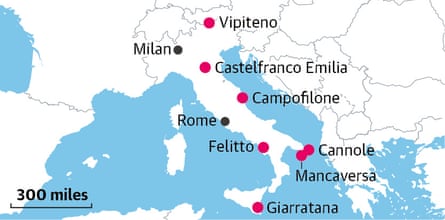
That place was Mancaversa, the seaside part of Taviano, where the Sagra tu Furese (mid August, dates to be finalised), which in Salentino dialect means the farmer’s festival, seemed to bring the whole village outdoors for dinner. From a small child’s perspective, it was a forest of legs and voices. I remember trying to pull my parents past the grown-up ritual of stopping every few yards to greet people they seemed to see only in summer, as we made our way towards the stalls near Piazza delle Rose, where men fanned embers with cardboard, sausages hissed on grills, horse-meat stew simmered in tomato sauce and gnummareddi (rolls of lamb offal) tempted the more adventurous.
Music came from a small stage and the village became an open-air sitting room, where people met over food that was ordinary for us, and almost incomprehensible to anyone who came to Salento looking for beaches and white light. No one would have thought to call them experiences. They were simply the proper way to get through summer, and in a country where a meal can quickly become expensive, they still make dinner feel possible for about €15.
Sometimes my parents, my brother and sister and I would go to Cannole. We would drive inland, passing through villages that all seemed to have a festival on. Only later did I understand that those roadside signs were a map of Italian summers, one I would go on to follow beyond Salento. Each led to a village gathered, for a few nights, around a dish of its own.
Cannole itself – a small town of just over 1,500 people – lies on the other side of the province of Lecce, towards Otranto and the Alimini lakes, and since 1985 the local Pro Loco Cerceto volunteer association has organised the Festa della Municeddha (10-14 Aug), dedicated to the small snail that has always been part of home cooking there.
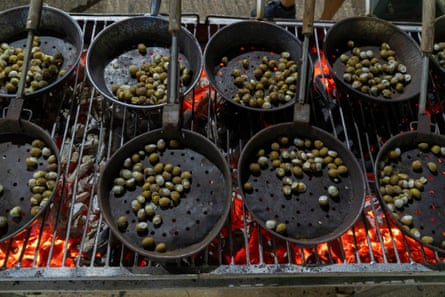
The municeddha is eaten in three main ways: in tomato sauce, cooked down with onion and oil, or roasted. But whichever the version, the method for consuming them is the same: you free it from the shell with a toothpick and eat it standing up. The festival today is large, with music, stalls and full tables, and is a far slicker operation than the one I remember.
Around 400 miles up the Adriatic coast, in the Marche, is the small town of Campofilone, on the hills above the Aso valley. Since 1964, its Sagra dei Maccheroncini di Campofilone IGP (7-10 Aug) has taken an extremely thin local pasta (maccheroncini) and transformed it into the centrepiece of a public feast: cut even finer, made with semolina and eggs and cooked in one minute. As soon as it is drained, it is tossed through red mixed-meat ragù on large wooden boards, where these very fine strands, so delicate when dry, become a compact mass, glossy with sauce, ready to be sent out to the tables.
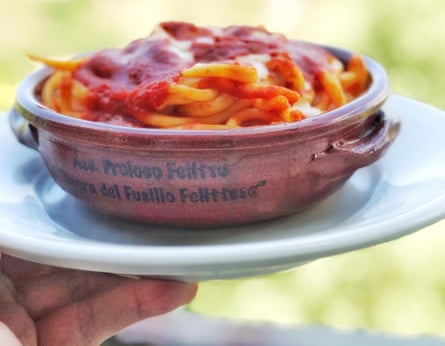
For the Sagra del Fusillo Felittese (13-23 Aug), set aside at least half a day. You leave the Cilento coast in the Campania region and climb inland, up to Felitto and the Gole del Calore (the Calore river gorge). The festival began in 1976 at Remolino, when fusillo (literally, little spindle) was used to bring people to the village. The reason to go is still the pasta: made with fresh eggs, long and hollow, rolled by hand around a thin iron rod. It is served with castrato ragù, traditionally made with goat from a castrated male animal, or with veal ragu.
If you’ve spent any time around Modena or Bologna in northern Italy (I moved to Modena to study at 18 and have lived there since), Castelfranco Emilia is the sort of place you’ll have passed through. At first I thought of it as a drive-through kind of town, but today I’m drawn to such places as they tend to keep their traditions fuss-free.
The tortellino, claimed by both Modena and Bologna, finds a nice compromise in Castelfranco. Legend says it was born here, at Locanda Corona, when an innkeeper glimpsed Venus’s navel through a keyhole and took it as his model. In practice, it is thinly rolled egg pasta, folded by hand around a filling of pork loin, prosciutto di Modena, mortadella di Bologna, parmigiano reggiano, egg and nutmeg. Here it is served in hot capon broth.
after newsletter promotion
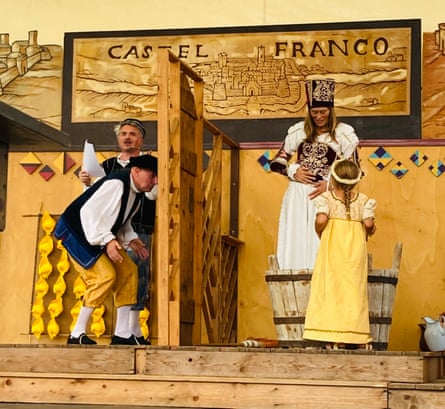
In September, Castelfranco holds the Sagra del Tortellino Tradizionale in Piazza Bergamini (4-14 Sept). What I remember is the square filling with long tables, people queueing at the cash desks and bowls of hot broth arriving one after another. Later, the parade leaves Corso Martiri like a small Renaissance pageant: women in brocade gowns and veils, men in caps and doublets, banners, music, and the innkeeper and noblewoman at the centre of the navel story that gave the tortellino its shape.
I arrived in Vipiteno, in Alto Adige/South Tyrol, in September, when summer in north Italy was cooling down. The Sagra dei Canederli (13 Sept) takes place during the day, and what I remember most is the strange orderliness of it: a 400-metre table laid with a gingham tablecloth in the historic centre, people finding a place, menus changing from one section to the next, and plates of dumplings arriving. It feels less like a fair than an alpine dining room laid out in the street, with folk music in the square and the mountains close enough to seem part of the meal.
A canederlo is a dumpling made from stale bread, eggs and milk – a way of using kitchen leftovers became one of the most recognisable dishes of these valleys. In Vipiteno, they come in broth, with speck, mushrooms, cheese and herbs; or sweet, with apricots or plums.
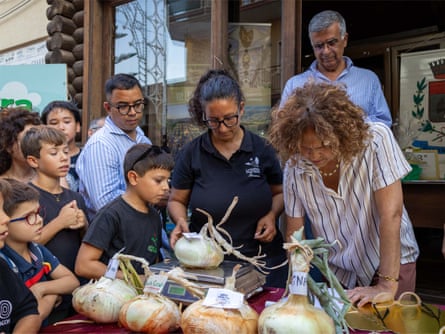
Sicily is at the southern end of the sagre map. I came to know Giarratana through the onion that bears the name of this village, in the south-east of the island. In August, those onions fuel an open-air supper and a small seasonal economy, with visitors coming to taste them where they are grown.
The Giarratana onion is large, flat and particularly sweet. It has been recognised by the Slow Food Presidia, and during the Sagra della Cipolla Giarratana (12-14 Aug), traditionally linked to the feast of San Bartolomeo, it fills markets, food stalls and tables along the village streets. It is served raw, finely sliced and dressed with olive oil, salt and cheese; baked whole or stuffed; or inside scaccia, a local speciality similar to a thin, folded focaccia. There are also hot dishes, preserves, local wine and music.
Giarratana is small: it is worth arriving before dark, parking outside the centre and, if accommodation in the village is full, staying in Ragusa, Modica or Chiaramonte Gulfi.
The Italy of sagre is too wide to fit inside a dining room and, for every silver cloche lifted, somewhere else in Italy there is a ticket number being called over a microphone and a dinner being served from a pot larger than anything you’d find in a home kitchen.







 English (US) ·