
 9 hours ago
4
9 hours ago
4
Sarah Brabbs used to be a fan of Michigan’s Democratic governor, Gretchen Whitmer.
“I have her book; I appreciated her stewardship and guidance during the pandemic,” Brabbs, who has voted Democrat for basically her entire life, says. “I will never not appreciate who she was during that time.”
Whitmer, who is term-limited having served eight years as governor, has characterized herself as a no-nonsense, “get-it-done” kind of politician. Her visibility in midwestern battleground states means she’s also seen by many as a potential Democratic front runner for the 2028 presidential election.
But in the eyes of many Democratic voters in Michigan, Whitmer tore up her White House ambitions by appearing on stage with OpenAI’s Sam Altman last month to celebrate one of the most divisive events in years for rural Michigan: The building of a controversial $16bn, enormous datacenter by OpenAI and Oracle in Saline township, a rural area west of Ann Arbor.
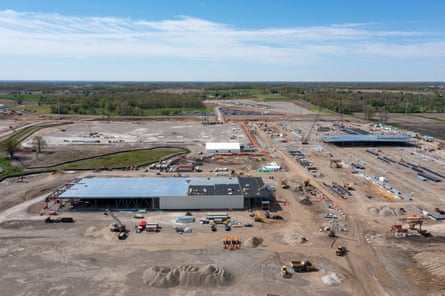
When Brabbs, who lives six miles from the datacenter, heard about Whitmer’s active support for the datacenter, her view changed.
“[I felt] just rage and sadness. For like a month it made me sick, just thinking about it,” she says of seeing Whitmer on a stage with AI company leaders. “I’m extremely angry watching her essentially throw us under the bus, casually.”
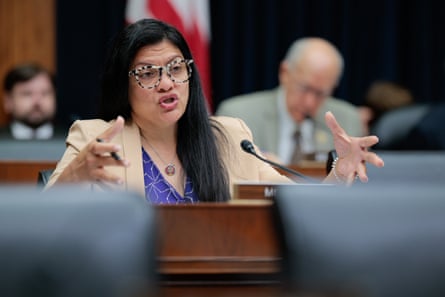
Michigan congresswoman Rashida Tlaib called the governor’s position “disgusting”.
For politicians in midwestern swing states such as Michigan, opposing the almost universally reviled datacenters should be an easy way to win votes.
And yet, one Democratic politician after another in battleground states has rolled out the red carpet for companies building these controversial, energy-intensive projects.
A recent Ipsos national poll found that Democratic voters “strongly/somewhat oppose” datacenters by a margin of 17% compared to their Republican counterparts. Only 9% of Democrats polled said they supported a datacenter in their own community compared with 21% of Republicans.
Notably, on Tuesday, New York became the first US state thus far to enact a moratorium on new datacenters. Governor Kathy Hochul issued an executive order mandating a one-year statewide pause on the large facilities.
Reports show that in Pennsylvania, the issue is bringing Republican and Democratic voters together.
In Wisconsin, a swing state where Donald Trump won by less than 1% in 2024, voters have been left furious with their Democratic party leaders’ support for datacenters.
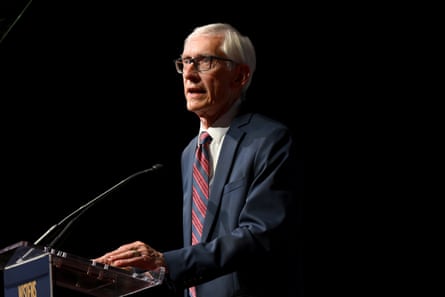
Wisconsin’s Democratic governor, Tony Evers, said in September that he and other Wisconsinites were “grateful” for Microsoft’s datacenter complex coming to Racine county, calling the facility in Mount Pleasant a “modern marvel”. Others think that’s a view that doesn’t represent Democratic voters across the state. Just one month after Evers’ announcement, Microsoft cancelled plans for a datacenter in Caledonia, also part of Racine county, in response to locals’ pushback.
“I think that [74-year-old] Tony Evers is a governor of his time [who believes that] you have to bring development to your communities and that’s how you’re going to raise revenue,” says Kelly Gallaher, chair of the Racine county Democratic party who lives about two miles from the Mount Pleasant datacenter complex.
“But the tide has really turned over the last couple of years … Right here, in southeast Wisconsin, we are so cynical and so skeptical of these kinds of projects. Our candidates have been very outspoken about the need for a moratorium on datacenters,” said Gallaher.
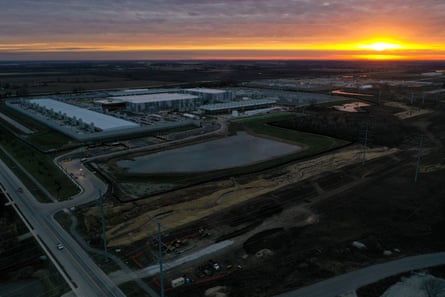
The Mount Pleasant site, bought by Microsoft in 2023, was formerly that of a failed, $10bn Foxconn project announced by the first Trump administration in 2017 that was expected to bring billions of dollars to the area.
The village of Mount Pleasant borrowed close to $1bn to part-fund the soon-to-be abandoned Foxconn project, meaning that when Microsoft inquired about setting up shop in town and investing millions of dollars, village leaders were largely receptive.
Last month, Microsoft announced the completion of Fairwater, which it claims is the world’s “most powerful supercomputer”, and the first of three datacenters it has planned for Racine county. The second is expected to open in 2028 and will collectively use up to 8.4m gallons of water annually. That water is provided by the city of Racine, which gets it supply from Lake Michigan.
“I think that the usage of incentives for these giant corporations have gotten completely out of control,” says Gallaher. “People are finally getting wise to it.”
In Michigan, where Trump prevailed by just 1.4% in the 2024 election in no small part due to Democratic party candidate Kamala Harris’ refusal to condemn Israel’s war on Gaza, establishment candidates are at risk of being wiped away amid a groundswell of anger at rising utility costs and a seemingly disregard for voters’ stances on datacenters.
The Democrats’ leading candidate for the governorship of Michigan, Jocelyn Benson, is married to Ryan Friedrichs of Related Companies, the real estate company tasked with bringing the datacenter to Saline Township. A survey of 600 likely general election voters in Michigan published in May found that an estimated 64% of Democrats opposed having a datacenter within 25 miles of their home, compared to 51.5% for Republicans.
One of the top Democratic party candidates for US senate, Abdul El-Sayed, a known Michigan progressive, has called for part-public ownership of datacenters. El-Sayed is leading Aipac-backed Haley Stevens in the Democratic primary, scheduled for 4 August, in many polls.
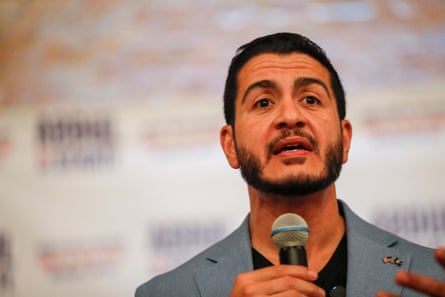
El-Sayed appears to be one of the few Democrats in Michigan to fully appreciate the anger datacenters have fueled in voters.
“I fucking hate it. I think [Oracle and OpenAI] really took advantage of this particular area with their big promises. There is not anything good that is happening for the township at all,” says Brabbs of the Saline Township datacenter project.
Emails sent to Whitmer’s office by the Guardian asking if she thought her support for datacenters could cost her politically in the future were not responded to.
“Even with all the environmental harms that this is, with how liberal Ann Arbor is, it’s kind of shocking how willing they are to totally keep their heads up their asses,” says Brabbs of the local Democratic party leadership.
Emails sent to Washtenaw county Democratic party leaders by the Guardian asking for the party’s position on the datacenter were initially not responded to and later blocked. The chair of the party declined to comment when reached by phone.
Brabbs says she is not opposed to datacenters in general.
“I’m not saying that they shouldn’t happen anywhere,” she says. “But the way that they’re happening is ridiculous, harmful and there’s nothing good about it.”






 English (US) ·