
 3 hours ago
3
3 hours ago
3
More than 100 people filled the council chamber at Houston city hall on Tuesday, spilling into the hallways as they waited their turn to address the mayor, John Whitmire, and the rest of the city council. Outside, a crowd gathered on the plaza. Their chants of “Do your job! Do your job!” carried through the chamber walls.
Nearly all were there to demand the same thing: accountability for the fatal shooting of Lorenzo Salgado Araujo by an Immigration and Customs Enforcement agent.
“ICE hunts us like animals,” testified Maria Cervantes, who immigrated from Mexico and grew up in the East End neighborhood where Salgado Araujo was shot. “I can’t help but think, who’s next? Am I going to get a bullet to the head for being brown?”
Salgado Araujo, a business owner and father of three, was shot dead in his vehicle while heading to a job site with his construction crew last Tuesday. The mayor has yet to explain whether the city will launch an independent investigation, while ICE has said Salgado Araujo was not the agency’s intended target.
Salgado Araujo’s death comes amid a wave of immigration enforcement activity across the country that has included fatal encounters in Minnesota and, more recently, a shooting in Maine that killed 26-year-old Joan Sebastián Durán Guerrero. The proximity of the two killings, in different states within the same week, has become a rallying point for organizers who say the pattern points to indiscriminate tactics rather than isolated incidents.
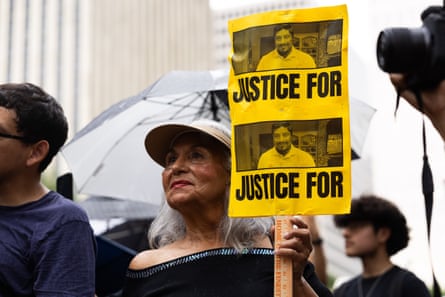
For Houston’s immigrant justice groups, Tuesday’s protest was not a starting point but a continuation of organizing that stretches back to before Donald Trump’s second inauguration, from outreach at the street corners where day laborers gather, to safety-planning sessions with local businesses. Now, the groups are doubling down on those efforts in the wake of the shooting – and only getting louder. Among their demands: the release of three men who were riding with Salgado Araujo at the time of the shooting, an independent investigation into the killing and the public release of the names of the ICE agents involved.
“We watched what happened in Minnesota and we are seeing what happened in Maine and now in Florida. It is absolutely ridiculous,” said Uncle Eagle, a local organizer with 50501 and the national No Kings coalition. “But this is bringing the coalition together. Trust and honesty, repeated over time, is what builds a community capable of sustained pressure.”
When the protest outside ended, Jasmine Khadem González, an immigrant rights organizer with Houston Democratic Socialists of America, did not go home. She led a Know Your Rights training, a routine she has carried out for more than a year, teaching people what to do if ICE agents show up at their home, their workplace or their car.
Eight people attended her Tuesday night training at a location kept private for safety reasons. González walked them through their constitutional protections, including the right to remain silent and the difference between an administrative warrant and a judicial one.
But the killing of Salgado Araujo, along with the recent ICE shootings of Durán in Maine and Renee Goode and Alex Pretti in Minneapolis in January, has forced González to adjust the training. Attendees now ask a harder question: what happens when ICE violates the very rights they are learning about?
In response, González’s training now includes more instructions for documenting agents in the field, filming when it is safe and noting badge numbers, license plates and timestamps, so that the record exists even when the law is not followed. She also spends significant time on what to do when it is someone else, a neighbor or a stranger, who is being detained, noting the lack of bystander footage when Salgado Araujo was killed.
At the Tuesday training, González stressed the importance of keeping the camera focused on the agents rather than on the person being detained, since it is the agents’ conduct that may be scrutinized later. “The day is going to come when we are going to hold these ICE agents accountable,” she said, “and we need to have all of the evidence possible.”
Houston’s immigrant rights activists secured a victory earlier this year, when the city council passed an ordinance limiting cooperation between the Houston police department and ICE. González said organizers had documented cases where HPD ran license plates during routine traffic stops, and if they discovered drivers had ICE administrative warrants, which carry no legal authority to arrest, police then held people at the scene, sometimes for hours, until federal agents arrived.
While the ordinance passed after months of mobilization, the governor, Greg Abbott, moved to withhold city grant funding a week later, and the council and mayor effectively repealed the ordinance in response. Organizers want the ordinance reinstated.
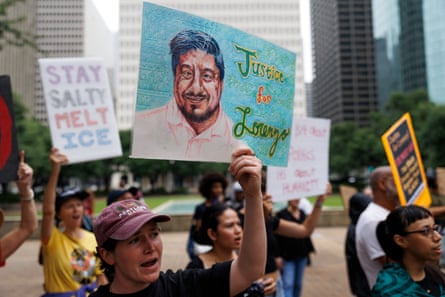
In the wake of Salgado Araujo’s killing, activists are also grappling with its impact on the East End, the tightly knit historically Latino community. “The connection that I draw [from the shooting] is that our immigrant and Hispanic Latino communities are disposable,” said Esmeralda Ledezma, who spent Tuesday inside the council chamber on behalf of the immigrant justice non-profit Woori Juntos. “We built the community brick by brick, and it gets torn down and redeveloped over the sake of money.”
Ledezma said the killing had forced a reckoning in the East End community, which is already struggling with displacement and rising costs, and where new development has accelerated as the city hosted Fifa World Cup matches. She said fears now run deeper than economic anxiety. Watching details of Salgado Araujo’s case unfold, she said, has left her uncertain what to tell her own parents – who immigrated to the United States from Mexico in search of a better life – each time they leave the house.
SEIU Texas, the labor union that represents more than 8,000 service workers in the state, had relocated its offices into the East End only weeks before the shooting, just blocks from where Salgado Araujo was killed. Its first event in the new location ended up being a vigil rather than the open house it had planned.
Elsa Caballero, the union’s president, said that Salgado Araujo had put three children through college, one of whom became a teacher. “These are working-class people who are thriving and making this economy better,” she said.
Caballero said the coalition’s most urgent ask of state leaders is for Texas’s Republican congressional delegation to speak out. “The more Republicans that actually start making demands,” she said, “the more likely something changes, because right now they’re the ones with the power.”
Organizers said canvassing efforts are expected to continue in the East End and beyond in the coming weeks, with protests planned every weekend and a larger mobilization planned around the city council’s 28 July evening session.
”We are sounding the alarm. We need ICE out of our city,” said Ledezma. “When ICE is on the ground, they kill. We cannot let this happen again.”





 English (US) ·