
 1 hour ago
5
1 hour ago
5
On the tree-lined streets of Wuhan, where cars jostle for space with mopeds and cargo trucks, the malfunctioning of a new type of vehicle has recently been causing chaos on the city’s roads.
In March, several cars from a fleet of driverless taxis stopped abruptly in the streets. The “system malfunction” left distressed riders stranded for hours. The robotaxis, known as Apollo Go and powered by artificial intelligence (AI), were taken off Wuhan’s streets for months for investigations.
But the outage was a boon for 45-year-old taxi driver Yao Xinnong. His wages, which had fallen by about 40% since Apollo Go launched in 2022, jumped back up as customers returned.
“I don’t really like them, to be honest,” Yao says of the driverless cabs operated by the tech giant Baidu. “Their impact has been huge”.
China is encouraging the deployment of AI at a scale unseen in the west. The technology is being rolled out at a staggering rate in an increasingly precarious labour market, and the Wuhan episode helped to highlight the social tensions it is causing.
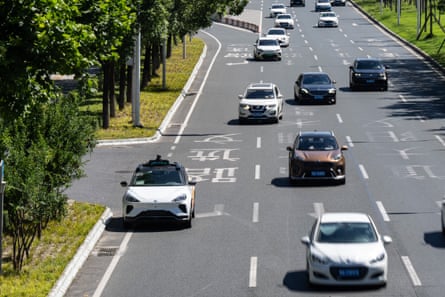
Gig workers like Yao are fearful about the impact of AI on their livelihoods, while recent incidents of white-collar workers being replaced by AI have also sparked a debate over whether workers should embrace the technology – or try to compete with it.
Addressing Shanghai’s World AI Conference in July, China’s leader, Xi Jinping, said that AI should be “an important driver for shared prosperity and common security”.
But that goal is being pursued amid an increasingly fragile labour market. As well as suffering from high levels of unemployment, China has seen tens of millions of workers drop out of formal employment into the gig economy. According to one thinktank, the number of people in flexible employment will rise to 320 million this year, up from 160 million in 2019. That is about 44% of China’s workforce.
Taxi drivers are one part of this huge cohort. Across the country, as previously heavyweight industries such as real estate and education have floundered, workers have turned to ride-hailing apps to make ends meet. But now the rollout of robotaxis, one of the most popular applications of AI that is already in use in China, is threatening their livelihoods.
“If the state really took you into consideration, Apollo Go would never have gone on the market,” says one Wuhan driver.
“If things keep going this way in the future, sure, rapid development and scientific progress are great, but ordinary people like us will have no place to survive,” she adds.
In 2024, taxi drivers in Wuhan protested against the rollout of Apollo Go in their city. It is unclear how many people took part, because news of the protests were quickly censored. Several drivers interviewed in Wuhan said they had heard about the protests but denied being involved.
That year, a Wuhan taxi company, took the rare step of publicly criticising the government’s policy to allow automation on to the city’s streets.
“The recent rise of autonomous ride-hailing vehicles has allowed technology to monopolise resources and take away the livelihoods of people at the bottom of society,” the letter said.
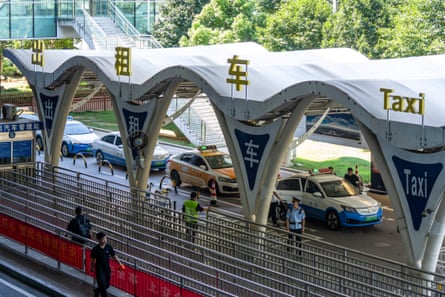
Authorities in China do not take kindly to public criticism. When the Guardian visited the taxi company’s office in July, an employee declined to be interviewed, citing an agreement with the police to refuse interviews and the risk of detention if he violated the agreement.
But two years later, the government is echoing some of the same concerns first voiced by the Wuhan drivers.
An editorial published in the state-run Workers’ Daily said that employment rights were “facing new challenges” in the age of AI. The article warned of a “collision between traditional employment rules and the iteration of AI technology”.
The government recently pledged to “comprehensively address the impact of changes in the external environment and the development of new technologies such as artificial intelligence on employment”.
Selina Xu, a China technology analyst, said there had been a “major vibe shift” from Beijing.
She says that after the success of local AI model DeepSeek last year, China was “very pro AI development”.
“This year, if you look at certain new guidelines that have been published … there has been a lot more emphasis placed on AI for boosting employment and people-first approaches,” Xu says.
Cheng Wanhui, an official for the local government in Beijing’s hi-tech zone of Zhongguancun, says that the authorities are “paying close attention to the social issues AI brings, as well as potential ethical concerns.”
“The key is for everyone to shift their mindset, see AI as a tool, and learn how to apply it in their future work,” Cheng says.
Recent court rulings have awarded compensation to white-collar workers laid off by their firms to be replaced by AI. But many workers fear the AI uptake will be a barrier to them being offered a job in the first place.
Tian Zemin, a cinematographer who works in Beijing, has worked in the film industry for nearly two decades. But now he’s out of work. “I spent six gruelling years working my way up to become a cinematographer, only to be replaced by a piece of software,” he wrote in a social media post about AI.
“I thought I would spend my whole life in this industry. But the emergence of AI has made me feel a huge shock for the first time,” he tells the Guardian.
Many of Tian’s peers are losing out as AI becomes more widely adopted across the film industry. His own rate as a freelancer is now 40% of what it was in 2019.
Tian said he’s been shocked at AI’s progress. Last year, it made shonky, weird looking avatars. Now it can make convincing digital clones who have the range to carry a feature length film. “We have barely had time to react,” Tian says.
Many analysts believe that China, where the government exerts significant control over the private sector, will be better placed than the US to contain the fallout from AI-related job losses. Beijing could for example instruct companies to comply with hiring quotas, Xu says.
But for Tian, protections may not come soon enough. “We could be replaced at any moment,” he says. “Perhaps the only thing we can do is adapt as quickly as possible, and try to find the corner that AI still cannot replace – but that corner is getting smaller and smaller.”
Additional research by Yu-chen Li








 English (US) ·