
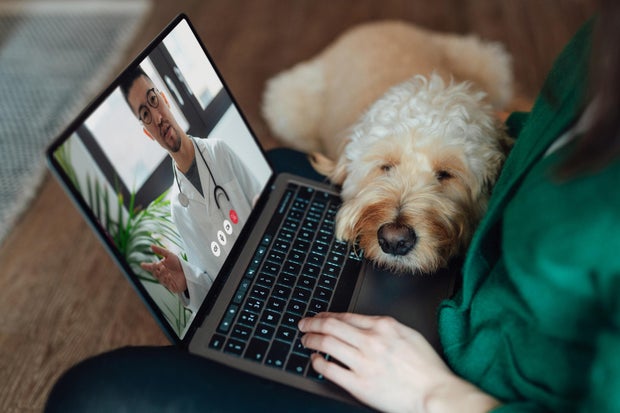
 While tele-vet care can be a useful tool for pet owners, it's not a complete replacement for in-person vet visits.
Oscar Wong/Getty Images
While tele-vet care can be a useful tool for pet owners, it's not a complete replacement for in-person vet visits.
Oscar Wong/Getty Images
A vet bill used to be an inconvenience, but for a growing number of pet owners, it's now a reason to stay home completely. Routine expenses for a single cat or dog — food, checkups, grooming and supplies — now average $4,272 a year, according to new research from Healthy Paws Pet Insurance. Stretched across a 12-year lifespan, that's more than $50,000 per pet, on par with a down payment on a home. Veterinary care prices alone have climbed about 43% since 2021, and nearly a third of owners say they're already spending more than they were a year ago.
Those numbers are changing behavior. Faced with a bill they couldn't afford, 38% of pet owners surveyed said they'd put it on a credit card, and 20% said they'd drain their savings to cover it. A growing number are delaying care altogether or looking for lower-cost alternatives.
Convenience has become part of that calculation. Between demanding work schedules, transportation limits and long clinic wait times, getting a pet to the vet isn't always simple — even when an owner knows they should go. That gap has helped fuel interest in tele-veterinary services, which let pet owners consult a licensed professional by video, chat or phone, often for a fraction of the cost of an in-person visit.
But tele-vet care isn't a full substitute for hands-on examination. Knowing where it helps — and where it doesn't — can make the difference between a smart shortcut and a costly delay.
Learn how Healthy Paws can help you keep vet care costs manageable.
When tele-vet care for your pet makes sense (and when it doesn't)
Tele-veterinary care has grown quickly as both costs and demand for flexible care options rise. But like any healthcare solution, it works best in specific situations and can be risky in others.
When tele-vet care makes sense
Virtual vet visits aren't a workaround or a lesser option. For the right situations, they're genuinely the better choice — faster, cheaper and more than adequate for what your pet actually needs. Here's when to consider it:
Minor behavioral concerns: If your dog has started chewing furniture, your cat is using the litter box inconsistently or you're noticing subtle changes in personality or energy levels, a tele-vet can help you assess whether there's an underlying medical issue or offer behavioral guidance. These conversations don't require a physical exam, making them a good candidate for a virtual visit.
Skin and coat issues that aren't acute: Is there a new patch of dry skin, mild itching or a small bump you've been watching on your pet? A vet can evaluate visible symptoms via video and advise on whether a topical treatment, diet change, or in-person follow-up makes sense.
Prescription refills and medication management: For pets with established chronic conditions — whether that's allergies, arthritis, thyroid disease or something else entirely — tele-vet appointments can be an efficient way to manage ongoing prescriptions or care without the stress and cost of a full office visit. This is one area where the format generally pays for itself quickly.
Post-surgical follow-up: If your pet recently had a procedure and you want a quick check on how an incision is healing or whether a symptom is normal, virtual care is often sufficient and far less disruptive than dragging a recovering animal back into a clinic.
General questions and triage: Not sure if what you're seeing is an emergency? A tele-vet can help you figure that out in real time — and point you toward urgent care when necessary. That kind of triage alone is worth the consultation fee.
Find out more about your Healthy Paws coverage options now.
When tele-vet care doesn't make sense
There are situations where virtual care isn't just inadequate. In these cases, it could also cost your pet critical time:
Emergencies and acute distress: Difficulty breathing, suspected poisoning, uncontrolled bleeding, seizures, collapse or any sudden change in condition requires an in-person visit immediately. Tele-vet platforms are clear about this themselves, but the temptation to "just do a quick call first" can delay life-saving care.
Diagnostic needs: A vet can't run bloodwork, take X-rays or perform a physical palpation over video. If your pet has been losing weight unexpectedly, vomiting repeatedly or showing signs of pain, those symptoms require hands-on evaluation and lab work to diagnose properly.
Anything requiring a physical prescription: While some telehealth platforms can prescribe in certain states, many cannot — and controlled substances, vaccines, and certain medications will still require an in-person relationship with a veterinarian.
Dental issues and ear infections: These may seem minor, but both require a direct physical examination to assess severity. A vet viewing your pet's mouth on a phone screen cannot determine whether a tooth needs extraction or an ear canal is inflamed.
The bottom line
Tele-vet care is a legitimate, useful tool, not a budget shortcut or a compromise. With nearly a third of pet owners reporting they're spending more on their pets than a year ago, and 38% saying they'd put an unaffordable vet bill on a credit card, anything that helps pet owners access professional guidance without unnecessary expense has real value. The key is knowing what it's built for. Use it strategically — for triage, chronic condition management and minor issues — and reserve in-person care for what truly requires it. Your pet's health, and your wallet, will be better for it.
Edited by Matt Richardson








 English (US) ·