
 1 hour ago
2
1 hour ago
2
As the lights rose during a recent screening of The Odyssey at the Arian open-air cinema on the Athens riviera, nervous laughter floated into the breeze. Moments earlier, Odysseus’s men had morphed into pigs during a grotesque feeding frenzy fuelled by drugged cheese and wine. Now, as the Bangles’ Eternal Flame played on the house speakers, no one seemed especially tempted by the concession stand’s hotdogs.
This is presumably the sort of scenario Christopher Nolan hoped to avoid when he decided against an intermission in his nearly three-hour-long adaptation of Homer’s Odyssey. In the epic’s country of origin, however, directors do not get the final word.
“In Greece, the intermission is a must,” said Fotis Georgopoulos, whose family has run Cine Foivos, a movie house in the Athens suburb of Peristeri, for 72 years. “People want to smoke, they want to go to the toilet, they want to discuss the movie. And they don’t want to lose even five minutes of it.”
At Foivos, The Odyssey’s interval came during a more elegant moment, as Odysseus sailed away from Circe’s island. Outside, Gina Alexopoulou, 24, welcomed the chance to tell her boyfriend that Nolan’s Laestrygonians were the work of seven-foot actors rather than CGI. Nearby, brothers Giorgios and Panagiotis Liolias, both in their 30s, were also having a smoke, though they would have preferred to watch the film uninterrupted.
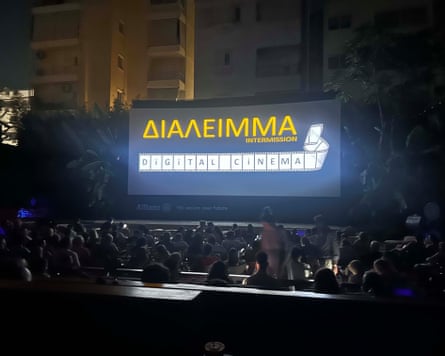
Until recent years, intermissions were standard practice at cinemas in Athens. In the early days, orchestras and theatrical troupes sometimes entertained audiences as projectionists changed reels. By 1960, when the city had at least 350 movie theatres, the intermission had become a social affair.
The tradition faded somewhat as multiplexes arrived in the late 1990s, independent theatres transitioned to digital projection in the 2000s, and Covid regulations briefly prohibited intermissions altogether. Now, customers who prefer the breaks – typically five to 10 minutes – often check for them at the box office or ticketing site.
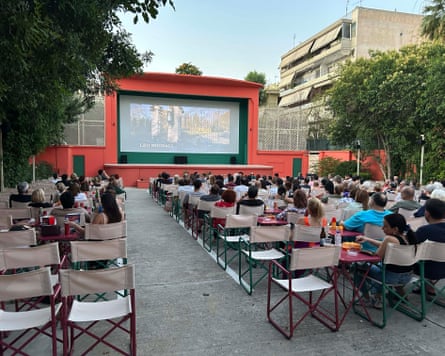
At the city’s longstanding summer cinemas, it’s a different story. At the halfway point of most any movie shown outdoors, patrons still shoot the proverbial breeze as they queue for cheese pies, homemade sour cherry juice and the ubiquitous Domino’s Pizza.
Intermissions are still deployed, though increasingly less so, in countries including Switzerland, Egypt, and Turkey, and are de rigueur in India, where Bollywood films are scripted with the interval in mind.
In Greece, they are crucial to cinemas’ survival. When Dafni Bechtsi took over Athens’ troubled Alexandra theatre in 2024 (now the Cinobo Patision), a midway break for refreshments was essential to her business model. Greek cinemas receive “no support from the government or anything, and they’re really struggling”, she said. “The revenue you get during the break, from food and drink, even if it might not be so much, is super critical.”
After winter, cinemas like the Cinobo Patision close for the season to make way for the city’s dozens of open-air ones. The interval becomes a chance to enjoy the bamboo-lined, Cyclades-style terrace at Cine Dexameni, or the view of the Acropolis from the rooftop Cine Paris. Seats are sometimes substituted with hammocks, sunbeds, or garden swings.
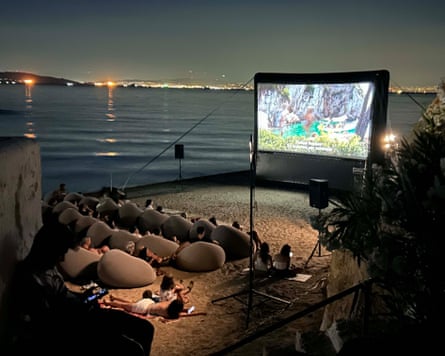
In one of the world’s most nocturnal cities, a midnight intermission can also be an opportunity to re-evaluate one’s night altogether and determine whether it’s worth watching the rest of a dud rather than joining friends at a concert or late dinner. Maybe it isn’t just a coincidence that the Greeks refer to the intermission as a diáleimma.
However some audience members remain sceptical. At the Electra, a loud grumble of “for fuck’s sake” greeted a bathroom break that shattered the tension of Backrooms. Other cuts are Oscar-worthy. At the open-air cinema abutting the War Museum, where ushers hand out blankets and pillows during the interval, Obsession was interrupted right as the unhinged protagonist urinated on the floor – the perfect cue to use the loo.
Projectionists have varying approaches to inserting restroom respites. Anastasia Kottaki, who works at Trianon, jumped straight to the middle of The Odyssey’s digital file to identify a suitable scene change. At Cine Alsos, a 61-year-old cinema tucked inside a wooded park, staff watched the movie in its entirety to choose the best moment and avoid stepping on any action sequences.
Mid-screening sales account for about 30% of the Alsos’s profits. Yet owner Giannis Chatzidimitriou insists that the social value of the intermission is equally important. A few years ago, he helped a customer pop the question by screening a proposal video during the interlude. The couple received a standing – and leg-stretching – ovation.
More than one marriage has blossomed over popcorn and passatempo, Greece’s beloved salted pumpkin seeds. Vrasidas Karalis, author of A History of Greek Cinema, recalls a friend meeting her future husband while queueing at the snack bar during Bernardo Bertolucci’s 1900. “Their hands touched, and they started talking about the upcoming revolution and the end of capitalist cruelty,” he says.
Karalis, who grew up in the Greater Athens area and now lives in Australia, says he misses the conversations that unfolded with old-timers working the canteen. “Most of them still are real eccentrics with something interesting to suggest about other films.”
Peggy Ringa, an archaeologist turned cinema-owner, counts herself among those enthusiasts. At her open-air cinemas – the Riviera, Vox and Athinaia – intermissions are “non-negotiable”. Longer films even get two of them. But they can still take visitors unaware.
While Béla Tarr’s two-and-a-half-hour-long Werckmeister Harmonies premiered in the country, said Ringa, the director was alarmed by the sight of audience members filing out of the auditorium halfway through. “The Greek distributors had a very difficult time convincing him that this was perfectly normal.”







 English (US) ·