
 5 hours ago
1
5 hours ago
1
It would be easy to think that the Odyssey, Homer’s epic poem composed over 2,500 years ago, is all about Odysseus. It’s called the Odyssey, after all. It opens with the invocation to the Muse, “Tell me about a complicated man” – pulling no punches about the poem’s theme. This is, on the surface of things, an epic about a man coming home, a return voyage that spans fluorescent fantasy worlds and yawns across 10 years in the wake of the fall of Troy; a one-hero clash with monsters and princesses, giants and whirlpools, the fight to reclaim his place as king of Ithaca, and as the hero of an epic of his own.
But the point about an epic is that it also contains multitudes. There is much that is epic about Christopher Nolan’s latest film. For those familiar with Nolan’s work, that hardly comes as a surprise. It’s a long watch, coming in at just under three hours. It reckons with the breadth of the Odyssean legend, from the sack of Troy all the way to Odysseus’s return, and seamlessly juggles the epic’s multiple timelines and flashbacks. And while the jaw-dropping cinematic effects of a feature film shot with Imax cameras might seem entirely modern, the way Nolan captures the smashing of a ship’s prow into the waves or the crunch of bones in the Cyclops’ jaws have their roots in the dynamic visuality of Homer’s poetry – what ancient commentators called enargeia, the epic’s ability to bring the world to life before your eyes.
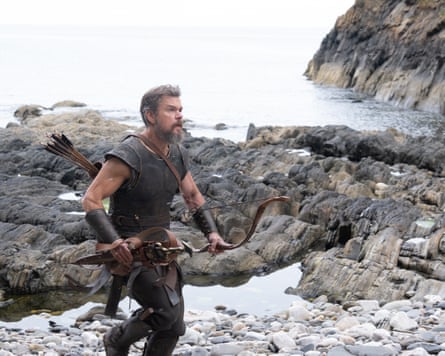
And then there’s the hero. Because, if the Odyssey is clear that it’s all about that complicated man, Odysseus, then Nolan is just as preoccupied with the complex hero – albeit in a different way from the Odyssey. Homer’s Odysseus is cunning with an edge of pride, a liar and a storyteller, with the smarts to wile himself out of any situation and a determination at almost any cost to get his homecoming. Those costs are spelled out many times by the poet before they’re tossed away. When the men who crew his ship back from Troy die (as they all end up doing), the common response in Homer is bitingly pragmatic: “We sailed off sadly, happy to survive, but with our good friends lost.”
Nolan’s Odysseus (played by Matt Damon) makes gestures to complexity too, but here is a modern-day Hollywood hero who learns remorse for the atrocities he commits and spends much of his time trying to excuse having lost all his men, and retrospectively (with a final journey, not in Homer, to pay homage to them) earning their forgiveness. There are glimmers of this, perhaps, in Homer’s epic (Odysseus meets one of his dead comrades in the underworld and goes back to bury him). Yet heroes, for the Greeks, are often destroyers of their communities in pursuit of what they want (think of Achilles in the Iliad asking Zeus to kill all the Greeks), not guilt-ridden survivors.
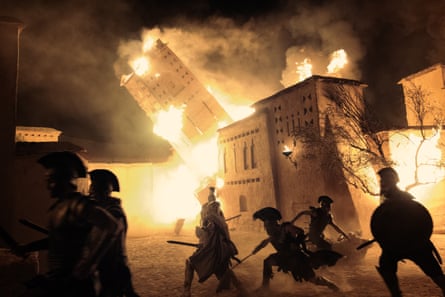
There’s another layer that Nolan adds: his Odysseus is riddled with trauma and guilt, not only for the deaths of his men, but for the death and destruction (and, at one brief point, the assault on women) he caused in Troy. A regular refrain in the film is the lament for the death of “our age of bronze”. This is a reference to Greece’s real bronze age – which preceded that of poets like Homer, which ended in a widespread civilisational collapse (including the real city of Troy), and was part-remembered in oral epics such as Homer’s Odyssey. Odysseus’s crime and atonement in Nolan, then, is not only for the loss of his crew, but also for the death of a civilisation.
Of course, Nolan isn’t just trying to replicate the Odyssey, and I’m not expecting him to. This is not – OK, not entirely – the chagrin of a Homerist missing her favourite scenes (no matter how I felt when I found out that Homer’s delightfully bash princess, Nausicaa, Odysseus’s key in getting back to Ithaca, had been chopped). What I’m pointing out is what is lost, or changed, in a Nolan–Hollywood–Homer crossover, and why that matters. As Nolan himself has said: “I was intrigued by the idea of a Hollywood studio taking on the biggest of stories.” So this is about uncovering what, in Nolan’s movie, looks like the Odyssey, and what is a product of his own choices. I’m here to think through what an epic hero and his world looks like to Nolan, and to Hollywood. And that is a really telling ride.
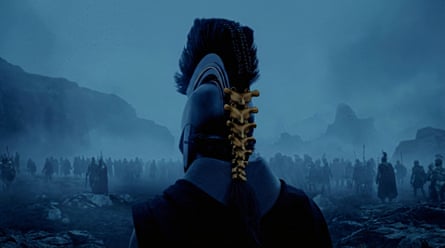
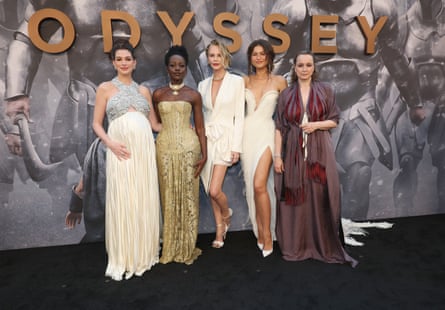
Because, yes, the Homeric epic is about Odysseus, and it’s about his journey home; it’s got gods and monsters, a father-fixated teenage son, Telemachus (Tom Holland), and a loyal wife, Penelope (Anne Hathaway). But it also has an Odysseus who ruins his companions’ homecoming because of his hubris when he brings a curse down on them all (omitted in Nolan’s film); who returns to Ithaca and slaughters a bunch of defenceless men (Homer’s Odysseus locks up the suitors’ weapons; Nolan gives them arms); makes his teenage son hang a group of enslaved women (Nolan inexcusably turns Penelope into the executor of her enslaved woman, Melantho, and has Penelope actually push her into the slaughter); and then (also not in Nolan) almost starts a civil war.
This is the root of the story from which Nolan’s film branches: a complicated man who isn’t a straightforwardly moral modern leader, but who makes choices that are vexed and troubling and often unclear. That’s true for many of Homer’s other characters, too – including the women. Female characters such as Calypso (Charlize Theron), the goddess with whom Odysseus spends seven years of his return, aren’t straightforward villains to be blamed for Odysseus’s multi-year absence from Ithaca (Nolan makes her drug Odysseus with the infamous lotus so he “forgets” his home). Nor is Penelope, in Homer’s epic, ready to admit that the beggar who has wandered into her household and executed most of the local nobility is actually her husband. Where is the challenge we see in Homer to whether she really wants him home or not?
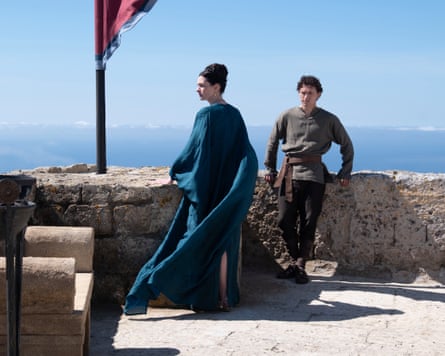
In Homer but not in Nolan, Penelope proffers a test of her own (the famous bed–test) before she lets her guard down, not only showing herself a match for her cunning, complex husband but demanding that the recognition between them goes two ways: that if he forces her to recognise him, then she will make him recognise her. And it’s the sum of examples like these, I think, that shows where Nolan’s film makes its departure – in the focus that is placed on Odysseus’s turmoil, his trauma, his inner voyage as a leader, and the way that ends up taking the air out of other stories.
Yet there’s something else to say here. Turning the Odyssey into Odysseus’s troubled journey to become an empathic leader of men and a reluctant agent of the onward march of history isn’t just a Hollywood reorientation to the kind of flawed genius we’ve seen in Oppenheimer – it fundamentally tells us what Nolan sees, and wants us to see, as a hero. For audiences who are looking for a box-office smash with stunning visual action, epic proportions and a hero at the heart of it all, they will get it. Every reworking of Homer says what it wants to the people it is speaking to.
In the gap between the sung verses of Homer and Matt Damon declaiming to an Imax camera, what this Odyssey offers us, by way of a hero and the grandiloquent experience of epic cinema, is a man who seeks redemption and solidarity among men, recognition from women, and absolution for a civilisation’s fall. Make of that, in the current climate, what you will.






 English (US) ·