
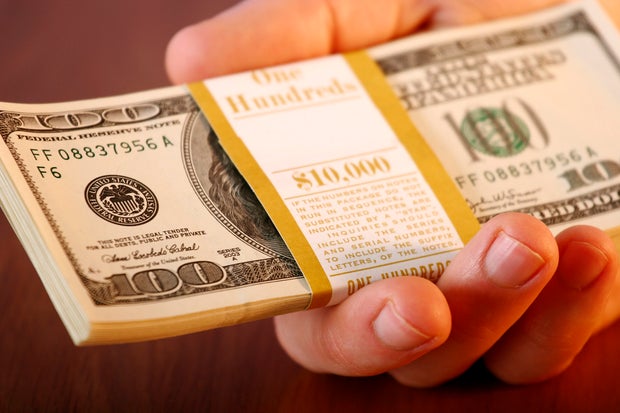
 Moving $10,000 into a 1-year CD or high-yield savings account could be a profitable decision for savers who take action now.
Cimmerian/Getty Images
Moving $10,000 into a 1-year CD or high-yield savings account could be a profitable decision for savers who take action now.
Cimmerian/Getty Images
If you have $10,000 currently sitting in a traditional savings account and are waiting on a big return on your five-figure deposit, you may find yourself waiting for a very long time. With an average interest rate of just 0.38% right now, according to the FDIC, interest earnings on an account of this size will be barely noticeable. And that's unfortunate in any economic climate but especially now with inflation still elevated and higher interest rates resulting in elevated borrowing costs. In this specific climate, it's especially important that the accounts savers are using are as effective and profitable as possible.
Fortunately, there are multiple viable alternatives of which a certificate of deposit (CD) and high-yield savings account are two. Interest rates on both sit around 4% right now and, with a CD, that rate will be fixed and the same until the account matures. A high-yield savings account, meanwhile, comes with a variable rate that can be unpredictable in a different economy but is widely expected to remain high and steady now. That said, the economy can change and the outlook can improve, so locking your money away for an extended period with a CD may not make financial sense. Securing it just over the next year, however, can be both profitable and a smart way to protect your principal through today's market uncertainty.
To better determine if a 1-year CD makes sense for your $10,000, however, it helps to compare the interest-earning potential against what a high-yield savings account is currently offering. Below, we'll crunch the numbers that savers should know with both options before getting started.
See how much interest you could be earning with a top savings account here.
$10,000 1-year CD vs. $10,000 high-yield savings account: Which will earn more interest?
Because the CD comes with a fixed interest rate and the high-yield savings account has a variable one, it can be difficult to match the interest-earning potential of each with precision. But with rates on high-yield savings accounts unlikely to dramatically rise or fall over the next 12 months, savers can still gain a reliable approximation of what they stand to earn with this size deposit.
Here's how much interest both account types can earn, calculated against the top rates available with each over the next year and the assumption that the high-yield savings account rate will remain constant:
- $10,000 1-year CD account at 4.17%: $417.00
- $10,000 high-yield savings account at 4.10% after one year: $410.00
- More profitable account: The CD will earn $7 more.
While the CD will be slightly profitable in this scenario, the numbers here don't tell the full story. If high-yield savings account rates rise, that account will become more profitable over this time period. Or, if savers simply add more money to their account during this time, they can potentially earn more interest.
That said, the variable rate works both ways and, if rates decline, even slightly, the interest-earning disparity between both accounts could easily become more pronounced. But with the interest-earning potential, as of summer 2026, looking similar, savers with $10,000 to deposit can feel reasonably comfortable with either option.
Learn about the high-rate CD account options available to you here.
The bottom line
Over the next 12 months, savers stand to earn between $410 and $417 with $10,000 deposited into either a CD account or a high-yield alternative, assuming today's rates hold. That said, it's important to shop around for rates and banks before getting started. Online banks, in particular, tend to offer more competitive rates than banks with in-person branch locations, so savers who are looking to make as much as they can with these account types are encouraged to start their search online. And with online marketplaces listing all of the information you'll need to compare your options, it's easier than ever to get started right away.
Edited by Angelica Leicht







 English (US) ·